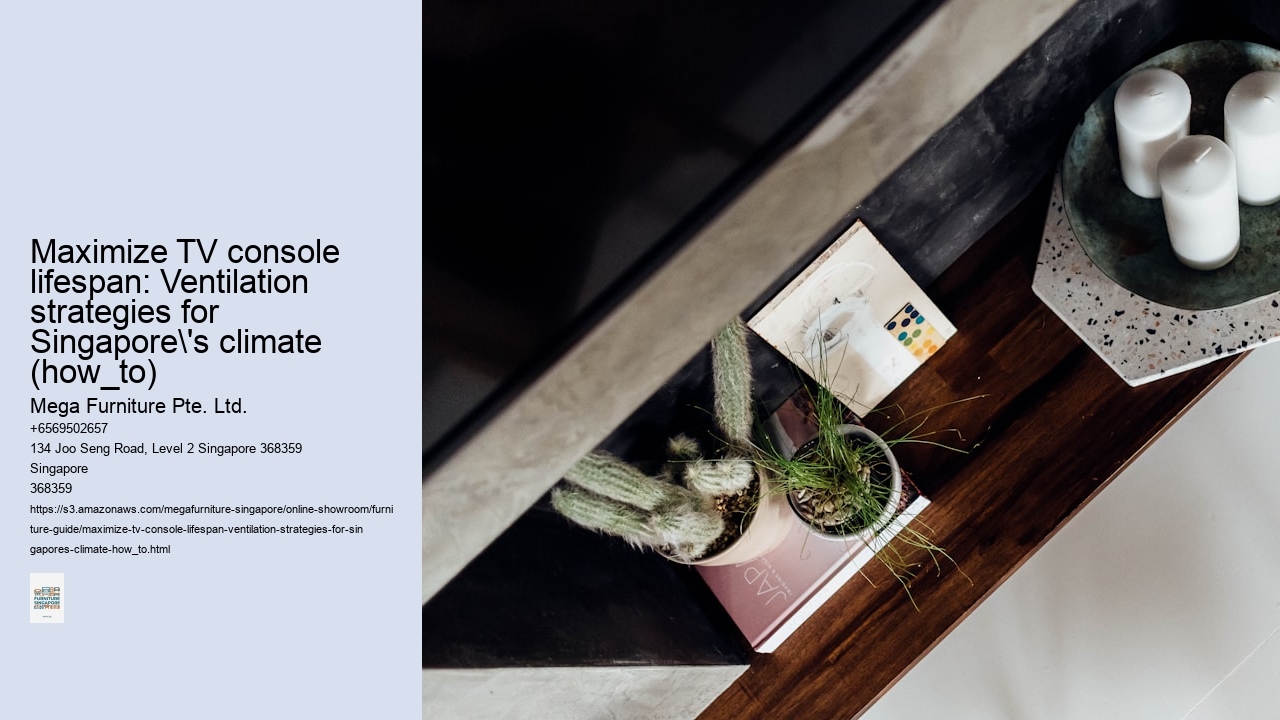
In a typical 4-room BTO living room, that sleek, enclosed console cabinet is a heat trap. AV components don’t just get warm—they bake, especially during our monsoon months when ambient humidity rarely dips below 80%. The result isn’t just a shortened lifespan for your PS5 or AV receiver; it’s moisture condensing on cold internal surfaces, a recipe for corrosion and failure.
That’s why passive airflow isn’t a luxury here—it’s mandatory. Start with the rear panel: a solid backboard is a common culprit. You’ll need a generous ventilation gap, at least 10cm from the wall, and strategic cable ports that don’t compromise the entire opening. It’s a basic measure many buyers overlook in favour of a cleaner look, but it’s the single most effective way to let rising heat escape.
For high-output gear, you need to go further. An AV receiver or modern gaming console should never be buried in a fully enclosed compartment. The solution is either a mesh-backed door, which allows air to pass while keeping dust at bay, or simply committing to open shelving for those specific units. It’s a functional trade-off; you sacrifice some visual tidiness for the certainty that your electronics won’t throttle themselves during a two-hour movie.
Cable management plays a surprising role, too. A tangled nest of wires at the rear can act as an insulator, blocking what little airflow you’ve designed. Use velcro straps or flexible conduits to keep cables organised and pressed flat against the wall, ensuring that crucial rear gap remains clear. In many homes, this simple step can drop internal cabinet temperature by several degrees.
Ultimately, choosing a console with these fundamentals in mind means looking past the finish and colour. It’s about spotting the design details that acknowledge our climate—like raised feet for under-cabinet airflow or perforated metal side panels. For a selection that prioritises these features, you can browse the TV console options at Megafurniture. The goal is simple: let the hardware breathe, so it doesn’t silently expire in the humidity.
Solid teak’s natural oils and tight grain give it a near-mythical resistance to Singapore’s humidity, meaning a console in a non-air-conditioned living room won’t warp or bow over years. That stability, however, comes with a serious price tag—often double or triple the cost of engineered alternatives for a 180cm piece. For a family in a five-room BTO, that might mean allocating $1,800 from the renovation budget just for this one statement item. You’re paying for a material that performs beautifully in our climate, but it’s a luxury that sidelines other upgrades.
Modern laminates and plywoods, when specified correctly, form a formidable barrier against moisture. The key is in the sealed edges; any chip or exposed particleboard core becomes a sponge for ambient humidity, leading to the dreaded swelling. Quality manufacturers use thick, thermally fused laminates and apply edge banding under high pressure, creating a continuous plastic shield. This engineering turns a sheet of compressed wood fibres into a product that can withstand the dampness of a ground-floor condo near Bedok Reservoir.
Staples and glue in particleboard cabinets are a short-term fix for a long-term problem—they loosen as the board itself degrades. What you want is sturdy joinery: dovetail or finger joints in solid wood drawers, and metal-on-metal glides for smooth operation. These details signal that the carcass is built to handle the weight of an AV receiver, gaming consoles, and books, not just to look good on delivery day. In a household with kids, that structural integrity matters more than a trendy finish.
Budget often dictates the final choice, and there’s a clear tier system. A 200cm solid wood console might run from $1,200 to over $2,400, while a comparable laminate version starts around $400. That gap buys a lot of other media gear, or simply makes a larger console feasible for a wall beneath a 75-inch TV. The pragmatic buyer weighs the material premium against the console’s expected lifespan in their specific flat—will it last through one homeowner’s tenure or become a bulky disposal issue in five years?
The surface treatment is the first line of defence. A polyurethane-coated solid wood can handle condensation from a cold drink, while a poor-quality laminate will stain and peel. For engineered options, look for textured finishes that mimic wood grain; they’re not just for aesthetics but help hide minor scratches from daily use. In a typical household, the console’s top acts as a landing zone for remotes, plants, and decor—its finish needs to be as resilient as its joinery.
A common sight in many 4-room BTO flats is a sleek, wall-hugging console with its rear vents pressed flush against the feature wall. It looks tidy, but that’s precisely the problem — buyers prioritise a clean aesthetic and forget that electronics need to breathe, especially in our humidity. Blocking those vents traps heat, turning the cabinet into a slow oven for your AV receiver or PlayStation, and you’ll likely notice the fan noise long before you see the component fail.
Another frequent misstep is ignoring the future-proofing math. A buyer might choose a 180cm console for their new 55-inch TV, pleased with the proportional look. Two years later, when upgrading to a 75-inch model, they discover the TV’s base stand requires 200cm. That leaves a costly choice: replace a perfectly good console or live with an overhang that looks precarious in a compact layout. It’s a classic case of solving for today’s purchase, not next year’s living room.
In family-centric layouts, the oversight often involves sharp corners and pet access. A console with squared-off, sintered stone edges might anchor the room visually, but it becomes a hazard zone in a narrow walkway between the sofa and dining area. Similarly, opting for a console with solid cabinet doors all round looks seamless, but it denies the family cat its favourite hiding spot, leading to scratched finishes as it tries to force an entry elsewhere.
The impulse to push furniture completely against the wall is strong in Singapore, where every centimetre counts. Yet that few inches of clearance behind a console isn’t wasted space — it’s a critical airflow channel. For a practical selection that considers both form and this necessary function, you can browse Megafurniture’s collection of TV consoles designed with ventilation in mind. The goal is to avoid creating a hot, dead zone behind your most expensive electronics, which, in our climate, is a sure way to shorten their lifespan.
The Joo Seng showroom’s lighting is bright enough to spot a fingerprint on a laminate door — a useful intensity when you’re checking for finish consistency across a console’s entire length. You’ll want to run a hand along the top and side edges of any piece you’re considering; inconsistencies in veneer alignment or a slight colour mismatch between panels are far easier to see under these fluorescent lights than in the warm glow of your own living room. For floating models, pay particular attention to the finish on the underside and the rear panel — areas often overlooked in production but visible in a typical 4-room BTO layout where the console might be approached from an angle. Drawer action is the true test here. Open and close every drawer on the floor-standing units, listening for a smooth, quiet roll and feeling for any lateral wobble. The staff at Joo Seng are accustomed to these inspections and can clarify the assembly specifics — whether drawers use metal runners or plastic wheels, and how the mounting system for a floating console integrates with your wall type. They’ll also confirm the exact internal dimensions, which is crucial for planning ventilation; a media unit that fits your 65-inch TV but leaves only 2cm of clearance behind your AV receiver is asking for trouble in our climate. Ventilation features, or the lack thereof, become apparent on close inspection. Many consoles in the range include patterned rear panels or cable management grommets, but you need to assess whether these openings are genuinely functional or merely decorative. A slatted back panel offers far better passive airflow than a solid one with a few small holes. For models with full-height backboards, check if there’s a dedicated ventilation channel at the top or if you’ll need to leave a more significant gap between the console and the wall. It’s a detail that separates a furniture piece that simply holds your gear from one that helps it survive Singapore’s humidity. The range spans sizes suitable for typical HDB living rooms, from around 180cm consoles for 55-inch TVs up to 240cm statements for 75-inch screens. While the build quality is generally solid for the price point, door alignment on some taller, floor-standing units can be slightly off — a quick adjustment during assembly usually fixes it, but it’s worth noting. If you’re considering a floating model, the showroom allows you to test the perceived sturdiness; a well-mounted console shouldn’t flex when you apply moderate pressure to its front edge. Your final decision often comes down to whether the unit’s actual ventilation provisions match your equipment list — something best verified in person before you commit. You can explore the full selection online at
Megafurniture’s TV console collection.
The delivery fee quoted online often assumes a ground-floor drop-off — in a resale flat, that means adding a staircase charge per floor, and it’s not uncommon for the crew to need a second trip for a 240cm console that won’t fit the lift. Confirm whether assembly is bundled or a separate line item; many buyers discover the hard way that basic flat-pack assembly doesn't cover complex wall-mounting for a floating console. That’s a job for a skilled installer, especially in older HDB blocks where you might hit uneven plaster or need to locate concrete beams.
You’ll want to check the warranty terms for exclusions related to Singapore's climate. Humidity-related damage, like warping in solid wood panels or mould in poorly ventilated compartments, is frequently listed as wear-and-tear, not a manufacturing defect. A typical two-year structural warranty should cover sagging shelves or failing drawer glides, but read the fine print for what constitutes 'proper use' — overloading a console with a 75-inch TV and three game consoles might void it.
For assembly, the real variable is your wall type. A contractor-grade feature wall in a BTO can handle a heavy mount, but a partition wall in a 1990s condo may require special anchors. Some retailers, like Megafurniture, offer professional installation services for their wall-mounted units, which can be worth the extra cost to avoid DIY disasters. It’s a sensible investment when you’re dealing with expensive electronics and a feature piece for your living room.
On warranties, the clock usually starts from the delivery date, not purchase. Keep your invoice and any assembly confirmation. If a console develops a lean or a door won’t close after a year, that’s the time to reference the structural defect clause — persistent issues like these, assuming no water damage or improper installation, should be covered. The challenge is often proving the fault was present at delivery, which is why clear photos during unpacking are useful.
The questions you get from friends at void deck coffeeshops are often more useful than any glossy brochure. They’re the real-world puzzles of fitting furniture into a 4-room BTO, where every centimetre and material choice matters.
Can a console sit against a non-load-bearing BTO wall? Yes, absolutely — that’s the whole point of a floating design. The key is using the proper heavy-duty brackets rated for the console’s weight and length, and securing them into the wall’s concrete studs, not just the plaster. A 180cm console filled with a soundbar and game consoles is a serious load.
Best material for homes with pets? Scratch-resistant laminate wins for most households. It’s a practical choice that can handle the occasional paw scramble or toy being batted underneath; a high-pressure laminate with a textured finish will hide minor scuffs better than a glossy veneer. For families with particularly enthusiastic cats, you might look at sintered stone tops, though the cost jumps considerably.
How to hide cables in a floating console? Use a centralised cable management tray mounted to the wall or the console’s underside. The cleanest installs run all wires from the TV down a single conduit in the wall, but if you’re not doing a chase wall, a good tray with adhesive backing and Velcro straps keeps the inevitable tangle of power bricks and HDMI cables from becoming an eyesore.
Does warranty cover laminate peeling in Singapore’s humidity? It varies dramatically by retailer. Some explicitly exclude ‘humidity damage’ as a wear-and-tear issue, while others offer longer guarantees on edge bonding. It’s a crucial question to ask before buying — get the coverage terms in writing, because that 90% humidity during monsoon season isn’t going anywhere.
The best-planned console purchase can still go wrong on delivery day, when a unit that looked perfect online simply won't fit past the lift lobby's corner. Measure your wall space with a steel tape, not a guess—account for the full 180cm or 240cm length, plus the extra 5cm on each side for doors to open fully. Don't forget to cross-check your TV's diagonal size against the console's recommended width; a 75-inch screen needs a base at least 170cm long to avoid that top-heavy look. Finally, tally the heat output: a PlayStation 5, AV receiver, and set-top box crammed into a sealed compartment will bake themselves within an hour in our humidity.
Material choice is a direct response to your housing type. For a BTO living room where walls might still be settling, a solid rubberwood or engineered wood console can handle minor shifts without splitting. Condo owners going for a built-in media wall look often opt for laminates or sintered stone tops that match their feature cladding, but these heavier materials demand a floor-standing design—floating variants need specific wall structures. Proven ventilation isn't just about back panels; it's in the details, like raised feet for under-cabinet airflow or mesh inserts in cabinet doors, which are non-negotiable for anyone running a gaming PC in the same unit.
Verify delivery logistics with your retailer well before confirming the order. Many older HDB blocks in neighbourhoods like Bedok or Toa Payoh have tighter stairwells and smaller lifts; a disassembled flat-pack delivery might be the only option for a 220cm console. Allocate a budget of around $200 to $400 for professional installation if you're dealing with a wall-mounted or floating model, especially if it requires drilling into reinforced concrete. It’s a prudent line item—what you save on DIY effort you’ll gain in a perfectly level installation that doesn't stress the mounting brackets.
Set aside about 10% of your total budget for unforeseen extras: longer HDMI cables to route through conduits, adhesive cable management clips, or even a small USB fan for a particularly packed cabinet. Then, with your measurements, material, and logistics locked in, you can finally browse the options with confidence.
The most common mistake in a Singapore living room isn't about style-it's about scale. A Bookshelf earns its place in Singapore homes through dual function — book and decor storage in the open shelves, soft visual division when placed mid-room in open-plan condominium layouts. A TV console anchors the wall opposite the sofa in the same way a tall bookshelf anchors a corner — long horizontal piece, mix of open and closed storage, defines the visual weight of one whole side of the room. Megafurniture's TV Console range covers floating wall-mounted designs, low-profile freestanding consoles, and modular feature-wall configurations. Most pieces sit at 40-50cm height, sized for screens up to 75 inches.. Megafurniture's combined display unit and bookshelf hub covers tall book racks, cubby-hole designs, ladder shelves, modular cube systems, and glass-door pieces in oak, walnut, and MDF veneer finishes. Solid-wood pieces typically start around $425, with most heights spanning 120cm to 220cm to fit standard 2.6m HDB ceilings.. A 65-inch television perched on a 140cm console looks precarious, an aesthetic imbalance that also limits practical storage for media players and game consoles. Display cabinets sit between bookshelf and storage cabinet in function — closed glass-front protection for the items you want visible but not collecting dust. Megafurniture's Storage Cabinet range covers glass-front, curio, wall-mounted, and freestanding configurations in solid wood, MDF, and metal-framed constructions. Average pricing for glass-front variants sits around $271, with LED-lit and motorised-shelf models commanding the higher tier.. The general rule is straightforward: a 55-inch TV needs around 160cm of console length, while a 65-inch model demands closer to 200cm. This proportional pairing ensures stability and a visually anchored media wall, especially critical in open-plan layouts where the console defines the entire zone.
In a standard 12 sqm BTO living room, that 200cm console becomes a major spatial commitment. It can dominate the wall, leaving little room for side tables or plant stands, and force a sofa placement that feels cramped. Here, the choice between a floating design and a floor-standing unit is more than aesthetic; a wall-mounted console with legs creates an impression of floor space, a visual trick that makes the room feel less crowded. Condo owners with dedicated media walls have more flexibility, but they still need to consider depth-a unit that's too deep can jut awkwardly into the walkway.
For landed properties with larger, formal living areas, substantial floor-standing consoles in solid wood or sintered stone become viable centrepieces. They offer generous concealed storage and can handle the visual weight of a 75-inch screen without issue. Back in a compact HDB, however, that same unit would overwhelm the space, making ventilation a secondary concern to sheer bulk. The console's footprint must leave ample clearance on all sides, not just for airflow but for daily living-you shouldn't have to sidle past it to reach the balcony.
Ultimately, getting the proportions right is the first step to ensuring longevity. A console that fits its room allows for proper air circulation behind and within it, preventing the heat buildup that warps materials and strains electronics. It's a foundational decision, one that balances the screen's demands with the reality of your floor plan.
The most common mistake in a Singapore living room isn't about style—it’s about scale. A 65-inch television perched on a 140cm console looks precarious, an aesthetic imbalance that also limits practical storage for media players and game consoles. The general rule is straightforward: a 55-inch TV needs around 160cm of console length, while a 65-inch model demands closer to 200cm. This proportional pairing ensures stability and a visually anchored media wall, especially critical in open-plan layouts where the console defines the entire zone.
In a standard 12 sqm BTO living room, that 200cm console becomes a major spatial commitment. It can dominate the wall, leaving little room for side tables or plant stands, and force a sofa placement that feels cramped. Here, the choice between a floating design and a floor-standing unit is more than aesthetic; a wall-mounted console with legs creates an impression of floor space, a visual trick that makes the room feel less crowded. Condo owners with dedicated media walls have more flexibility, but they still need to consider depth—a unit that’s too deep can jut awkwardly into the walkway.
For landed properties with larger, formal living areas, substantial floor-standing consoles in solid wood or sintered stone become viable centrepieces. They offer generous concealed storage and can handle the visual weight of a 75-inch screen without issue. Back in a compact HDB, however, that same unit would overwhelm the space, making ventilation a secondary concern to sheer bulk. The console’s footprint must leave ample clearance on all sides, not just for airflow but for daily living—you shouldn’t have to sidle past it to reach the balcony.
Ultimately, getting the proportions right is the first step to ensuring longevity. A console that fits its room allows for proper air circulation behind and within it, preventing the heat buildup that warps materials and strains electronics. It’s a foundational decision, one that balances the screen’s demands with the reality of your floor plan.